
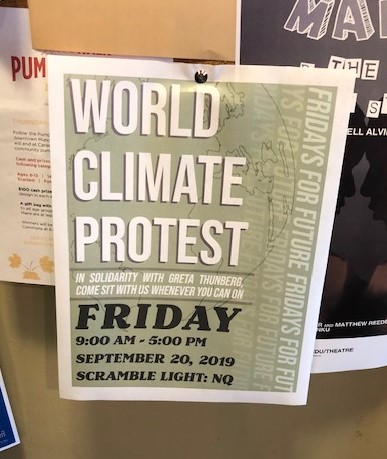
If you were on campus last Friday, you may have noticed something interesting at the scramble light. For those of you who don’t know Ball State’s campus, the scramble light is a large cross walk where hoards of students cross the street to go to their different classes. On the corners of the sidewalks people and organizations are allowed to gather to support and communicate an event or issue. This can take the form of supporting a charity, notifying people of an event, or promoting a key issue. In this case, it was a strike for the status of the global climate. It was a very intense gathering with a lot of people passionate about the issue. After that, I saw on the news that this wasn’t just a Ball State thing, this was happening all over the globe. So, what is this world climate protest about?
The Global Climate Strike is going on the last two Fridays in September and are being organized in 150 countries. The protest in an attempt to shed light on the impact humans have on the environment. Greta Thunberg is a 16-year-old, Swedish environmental activist that started this movement by skipping school to protest to her government for stronger climate action. This led to Fridays For Future school strikes for the climate, where students left school on Fridays to strike for the climate crisis. These recent strikes on the 20th and 27th are designed for everyone, not just students, to take to the streets and join the movement. The goal is to create enough disruption that politicians and policymakers will have to give attention to the state of our climate and make an effort to fix it. Some strikers are out to protest a specific environmental issue in their community.
There are many arguments for environmental regulations and this issue also brings up some ethical dilemmas. These climate strikers are calling for a shift away from fossil fuels and a shift to renewable energy sources. They are demanding climate justice for all. The argument here is that our planet is getting hotter with more sporadic weather conditions and it isn’t affecting everyone equally around the globe. Living here in Muncie, IN the weather seems irregular, but it isn’t life or death. It’s just a little difficult to predict what the weather will be. However, some people in other communities are being hit with more intense weather conditions, and with the seas rising some communities are in danger of losing their homes. The dilemma here is that I am contributing to these intense conditions for people by using fossil fuels, and they are being disproportionately affected by this simply because of differences in geography.
It is difficult to see the cause and effect relationship between our actions and their effects with this issue because the effects don’t happen right away, and they may not even affect us at all. The morality of this situation is not intuitive, and the implications of our actions aren’t easily distinguishable. Either way, we should do everything in our power to protect this planet and preserve the natural environment around us. I think it would be very unwise not to do so.
 The Great Outdoors